Prevent Social Engineering and Insider Threat Across Every Channel
Simulate attacks across email, SMS, voice, video, and encrypted apps, score user risk using integrated signals, and automatically prioritize remediation based on role and behavior.


Trusted by Fortune 1,000 Companies

.svg)





Security Awareness Training Is Broken.
Legacy SAT programs treat every employee the same, ignoring access levels, user behavior, and real-time risk, leaving you exposed to modern attacks.
Dune replaces ineffective training and static testing with live risk scoring, adaptive remediation, and automated defense, reducing user driven risk, strengthening security culture, and saving time across your organization.

User Adaptive Risk Management
Dune's User Adaptive Risk Management platform simulates multi-channel attacks, integrates behavioral and contextual data, and automatically adapts training, alerts, and controls to each individual’s risk profile to prevent user-driven breaches.
Risk Inputs
Risk Remediation

Business Impact

Attack Simulation Agent

Training Agent

External Security Integrations

Flexible Weights
Executive Reporting
Delivers clean, high-level insights into user risk, threat exposure, and security posture.
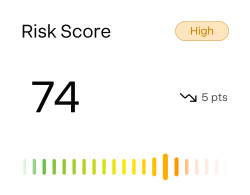
Exposure Prioritization
Escalates remediation for high-risk users to focus action and save time on low-risk users.
Agent
Most Users

Training Agent
Highest Risk Users (5%)

Access Restrictions

Dynamic Enforcement

Performance Management
Risk Inputs
Business Impact
Attack Simulation Agent
Training Agent
External Security Integrations
Flexible Weights
Risk Score
Executive Reporting
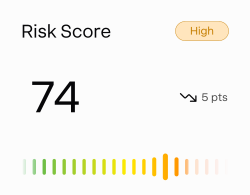
Exposure Prioritization
Risk Remediation
Most Users
Training Agent
Highest Risk Users (5%)
Access Restrictions
Dynamic Enforcement
Performance Management
Measure User Risk
Quantify individual user exposure by combining AI-driven context analysis, behavioral signals, and simulation performance. Identify which users are most likely to cause a breach.
- Real-time insight into breach risk
- Behavioral and contextual signals
- Remediation prioritized by exposure
Simulate Attacks
Launch continuous, omni-channel simulations – spear phishing, smishing, deepfakes, and encrypted threats – tailored to each user to expose attack susceptibility and insider risk.
- Omni-channel red teaming
- User-specific, real-world attack paths
- Measurable behavioral insights
Reduce Threat Exposure
Automatically adapt training, alerts, and controls based on each user’s behavior and risk profile. Minimize friction for low-risk users while escalating protection where needed.
- Risk-aligned microtraining per user
- Automated IAM & SecOps triggers
- Real-time enforcement & remediation
Business Impact
Evaluates each user's role, level, and function to calculate potential breach impact on the organization.
Attack Simulation Agent
Simulates social engineering attacks via spear phishing, SMS smishing, voice call vishing, and encrypted-channel attacks.
Training Agent
Captures user engagement and sentiment across just-in-time compliance, role-based, and org-specific training.
External Security Integrations
Ingests unlimited signals from your security stack (IAM, SEG, EDR, DLP, HRIS, and more) to build a single, continuously updated view of each user’s real-world exposure.
Flexible Weights
Gives security teams control over how attack activity, training, signals, and business impact weight each user's risk score.
Training Agent
Delivers just-in-time training tailored to each user's behavior, risk profile, and role.
Access Restrictions
Triggers access restriction workflows when a user’s risk score exceeds defined policy thresholds.
Dynamic Enforcement
Surfaces risk-based enforcement recommendations and routes them to the appropriate control systems.
Performance Management
Gives leadership real-time, comprehensive visibility into the highest-risk users, with prioritized risk data and actionable context.
Executive Reporting
Delivers clean, high-level insights into user risk, threat exposure, and security posture.
Exposure Prioritization
Escalates remediation for high-risk users to focus action and save time on low-risk users.
How Dune Secures the User Layer
Modern attacks are conversational, cross-channel, and invisible to legacy tools. Dune closes that exposure gap and acts in real-time. Dune delivers continuous visibility into how attackers reach users, identifies which users create the most risk, prioritizes exposures, and automatically remediates user risk as threats unfold.

Attackers exploit conversations across email, SMS, voice, video, and encrypted messaging apps to manipulate users and bypass traditional controls.
Dune continuously simulates real-world social engineering attacks across every communication channel users rely on, including SMS and encrypted apps like WhatsApp, Viber, Signal, and Telegram. These simulations mirror how modern attackers operate, using multi-step interactions and impersonation tactics that adapt based on user responses.
Wherever attackers can reach users, Dune exposes those risks so you focus on securing who matters most.
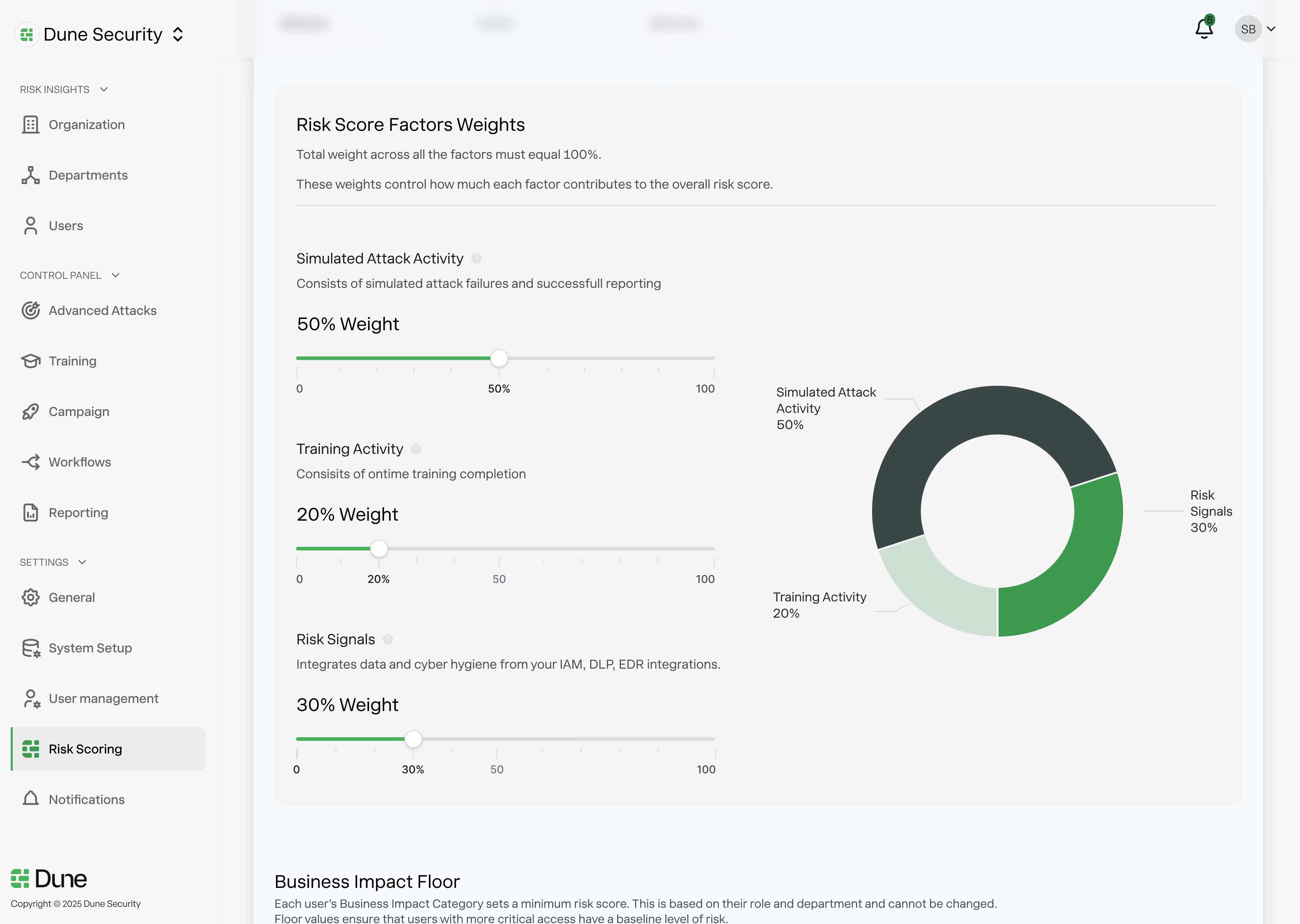
Not all users create the same level of risk. Identifying the highest risk users requires more than a single signal.
Dune calculates dynamic, user-level risk scores by combining multiple real-world risk inputs. These include vulnerability to omni-channel attacks, user behavior during live simulations, training activity and engagement, role-based business impact, signals from existing security integrations, and relevant historical data.
By correlating these inputs in real-time, Dune shows which users are most likely to be exploited and which compromises would have the greatest business impact. This allows security teams to focus attention on the small percentage of users driving the majority of organizational risk.
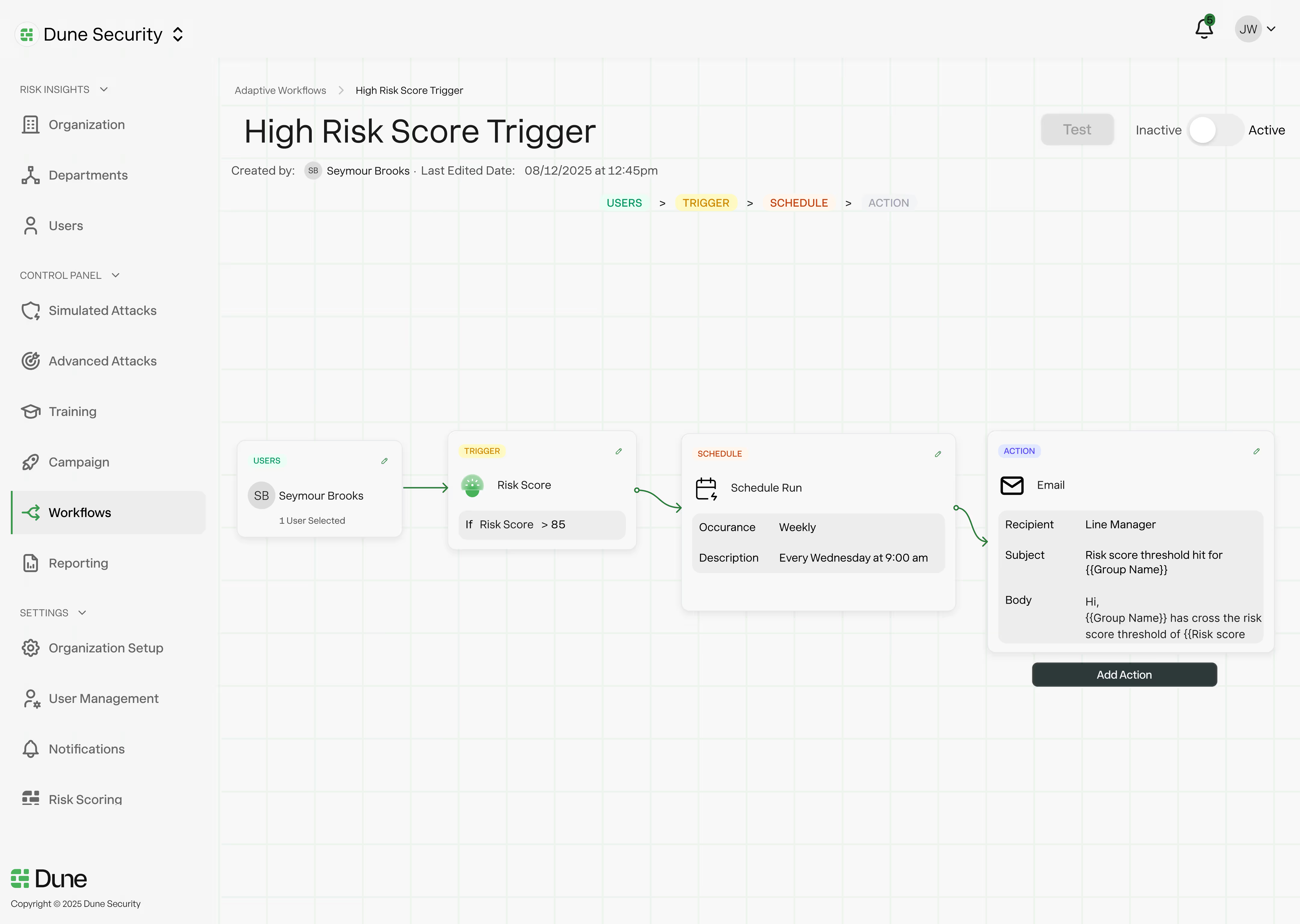
User risk is not static, and remediation should not rely on manual follow-up or one-size-fits-all training.
Dune automatically remediates user risk by adapting simulations, delivering targeted training, and triggering security workflows based on real behavior. When users demonstrate elevated risk, Dune increases testing, delivers role and behavior-specific microtraining, and applies the appropriate security controls. When risk decreases, friction is reduced.
Training is delivered only when and where it is needed, informed by how users actually behave under real attack conditions. This approach reinforces secure behavior without training fatigue and ensures remediation scales automatically across the organization.

Integrations
.avif)


Scalable and secure for the world’s largest companies
Frameworks

Certified – Jan 2024 & Jan 2025

Certified – Aug 2024

Compliance Verified – Jan 2025

Compliance Verified – Jan 2025

Third-Party Attested – Apr 2025

Third-Party Attested – May 2025
Ready to protect your company & employees from social engineering attacks?
Security Leadership That Understands Enterprise Risk




.avif)













We’re backed by incredible investors


Testimonials



reduction in average user risk scores through targeted training that cut exposure across 90+ countries.
less time spent managing training logistics by automating workflows and eliminating manual overhead.
increase in detection of social engineering vulnerabilities with adaptive simulations that exposed hidden risks.

of manual training replaced with automated, role-specific modules tailored for higher education.
weeks less time spent managing training logistics by automating workflows and eliminating manual overhead.
month to achieve full visibility into user and department-level risk for the first time across the organization.

reduction in user risk scores projected within 45 days through localized, role and risk-specific micro-training.
increase in training completion and engagement rates as employees began actively interacting with simulations.
languages launched within one month to scale global security awareness with high adoption

Why Dune Security Wins
Feature | Dune Security | Next-Gen SAT | Legacy SAT |
|---|---|---|---|
Real-Time User Risk Scoring |  | – | – |
| Behavioral & Role-Based Risk Signals | | – | – |
| Automated, Risk-Based Security Controls | | – | – |
| Seamless Integration Across IAM, SEG, EDR & DLP | | – | – |
| GenAI-Powered, Role-Specific Attack Simulation | | | – |
| Adaptive, Just-in-Time Security Training | | | – |
| Admin Automation & Real-Time Risk Reporting | | | – |
FAQs

Ready to see Dune Security in action?
"We can't keep doing the same thing and expect different results. Dune Security is doing something new and exciting, and they’re showing quantifiable outcomes."

Jeremy Livingston